Calendars are the core of the plugin.
Custom calendars are defined using YAML frontmatter inside dedicated calendar notes. The plugin supports multiple different types of calendars.
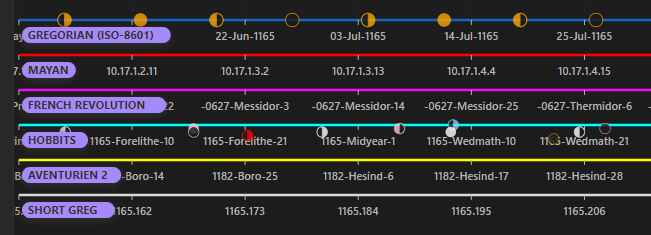
The following screenshot shows 6 calendars.
Tip
Note that you can click a calendar badge to open its note in a new tab.
Basic Properties
| Property | Short Description | Examples |
|---|---|---|
id | Mandatory, unique identifier. | shire |
name | Full name of the calendar. | The Shire Reckoning |
displayName | Short name displayed at the chart axis. | Hobbits |
type | Calendar Type. | rule-based | positional |
delimiter | Character separating date parts. | -, /, . |
sharedOffset | Offset in days to your base calendar. | +- (any integer) |
bcSuffix | Date Suffix for years prior to epoch. | BCE, BC |
adSuffix | Suffix for post-epoch years. | CE, AD |
moons | List of moons. | See moons example |
today | Any date in this calendar’s format. | 1234-Agosto-23 |
Calendar Type
A calendar’s type is limited to `rule-based` or `positional`.
They define which YAML properties are mandatory and which are optional.
Rule-Based
Calendars of this type are based on several rules.
Allows custom month lengths, intercalary days, and specific leap year rules. An extensive example would be:
  daysInStandardYear: number              # number of total days in a non-leap year
  noYearZero: boolean                     # (optional) boolean, true makes year go directly from 1 BCE to 1 CE
  leapYearRule: # see below, (optional) leap year rule
    ruleType: 'gregorian'                 # string: 'interval' | 'gregorian'
    intervalYears: number                 # (optional for type 'gregorian') number of years from 1 leap year to another
    extraDays: number                     # (optional for type 'gregorian') number of extra days (default: 1)
    applyToMonthIndex: number             # (optional for type 'gregorian') index of month
  months: # see below, list of months
    days: number                          # number of days in month
    name: string                          # (optional) string, full name of month
    shortname: string                     # (optional) string, short name of month
    isIntercalary: boolean                # (optional) boolean (default: false)
  format: ['year', 'month', 'day']        # any combination of these 3 values in any order, may omit 'month'
  outputFormat: ['day', 'month', 'year']  # (optional) same values as format in different order (default: same as format)
Months
Months are generally optional. If given, they are defined like this:
  months:
    - {shortname: "Jag", name: "Jaguar", days: 31} # short notation
    - shortname: "Feb"        # long notation goes over multiple lines
      name: "February"
      days: 22
    - days: 45                # omitting names is totally fine
    - name: Midyear
      days: 1
      isIntercalary: true     # not part of a month (for example see Hobbit calendar)
A calendar without months could look like this
ruleBasedDetails:
  format:
    - "year"
    - "day"
  months: []
Positional
Uses fixed numeric units instead of traditional months (e.g., Mesoamerican/Mayan count cycles).
.. work in progress
Traits & Settings
- Calendar notes are automatically indexed when placed in your configured calendar folder.
- For global calendar settings, see Plugin Settings > Calendar Configuration.